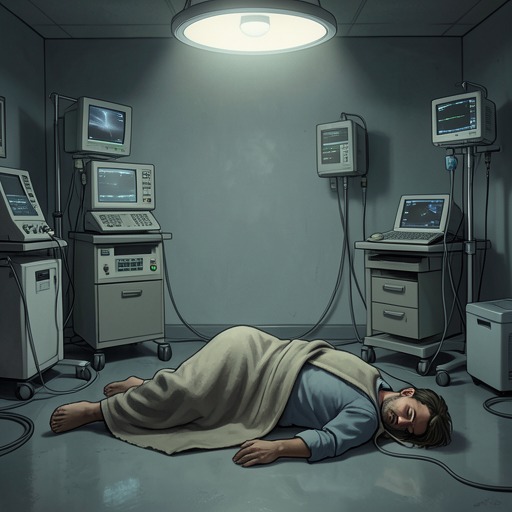
Monroe Street Parking Garage
The Time Traveler's WifeThe Monroe Street Parking Garage is the setting for a devastating temporal loop in which Henry DeTamble, stranded naked and exposed to extreme cold, calls his own earlier self for rescue. Clare Abshire drives to the garage after receiving that call, but arrives too late to find him. The site’s empty lanes, dangling receiver, and locked security station make a place built for cars into a stark measure of time displacement’s bodily cost: the call is answered, yet help cannot reach the version of Henry who needs it.
Setting and Place in the Story
The garage appears as a subterranean concrete space beneath downtown Chicago, reached by a descent from the deserted streets into a largely vacant structure. Its northwest end and the pay phone near the security station become the specific coordinates Henry gives Clare. When she reaches the phone, its receiver hangs from the cord; the guard station is unattended, and its video monitors show empty concrete. The vacancy is not merely atmosphere: it is the visible gap between the two versions of Henry, one who has called and one who has not yet arrived.
The location also belongs to a wider pattern in Henry’s time-displaced life. He describes appearing without clothes or possessions, often in places where concealment and escape are difficult. In Chicago, his repeated disappearances while in police custody have left him facing outstanding warrants for offenses including trespassing, robbery, and indecent exposure. At the Newberry Library, the steel Cage in a windowless stairwell is another enclosed space he fears; in a later episode he comes to inside it after hours, injured and cold. These spaces differ, but each exposes how buildings and systems designed for ordinary use can become traps for a person whose arrival and departure are beyond his control.
The January 2006 Search
In the early hours of January 7, 2006, the telephone rings while Clare and Henry are asleep. Henry answers, listens, and tells the caller they will leave at once. Clare asks who called; Henry explains that it was himself, stranded in the Monroe Street Parking Garage without clothes in temperatures fifteen degrees below zero. His immediate answer turns a familiar domestic bedroom into the starting point of an urgent rescue attempt.
Clare and Henry dress hastily and gather clothes and protection for the stranded Henry: a shirt, long underwear, jeans, socks, boots, an extra coat, mittens, and a blanket. They wake their daughter Alba and take her with them. Snow and ice slow the drive from Ainslie, but Clare reaches Lake Shore Drive and hurries through the empty winter city toward the garage. The practical urgency of the clothing and the sleeping child in the car keeps the episode grounded in family life even as its premise depends on the impossible fact that Henry has called himself across time.
At the garage, Henry directs Clare to the pay phone by the security station. She finds only the dangling receiver and no sign of him. The protective sense of déjà vu that had accompanied the drive disappears, leaving Clare with no reliable sign of where or when the other Henry went. She and Henry search the vacant levels, passing concrete pillars and signs that direct drivers to go slowly and remember where they parked. They find no one. The search ends in uncertainty rather than rescue: Henry’s call has brought Clare to the right place, but not to the moment when he is there.
The Call Replayed from Henry’s Side
The episode returns from Henry’s perspective in a later account of the same night. He wakes in snow in Grant Park, unable to feel or move his feet. After staggering and then crawling across the snow and through the city, he reaches the garage’s pay phone. He calls his own earlier self, identifies his location as the Monroe Street Parking Garage near the guard station, and asks to be picked up. The answering voice agrees to leave immediately—the call Clare heard from the bedroom.
The garage offers no shelter once Henry reaches it. He crawls to the security station and sees a space heater, a jacket, a desk, and a chair inside, but the door is locked and the wire-reinforced window cannot be opened. No guard is present, and there are no cars below. Henry calls for help and curls against the door, wrapping his hands around his feet. At last he disappears, before Clare and the other Henry arrive. The earlier search scene is thus reinterpreted: its empty receiver and vacant garage are not signs that the call was imaginary, but evidence that the rescue party has missed the brief interval in which the suffering Henry is still there.
Temporal Loop and Bodily Consequences
The exchange closes into a painful causal circle. The injured Henry calls the past; the past Henry hears the call and sets out with Clare; but the caller vanishes before they can reach him. The call succeeds as communication and fails as rescue. By presenting the same event from both sides, the narrative makes the reader hold together two incompatible-seeming conditions: Henry is present at the garage long enough to plead for help and absent by the time help arrives.
The setting sharpens the physical stakes of that structure. Henry’s displacement leaves him without clothing or protection, and the freezing exposure damages his feet so severely that he later tells Kimy he has no feet. The garage’s locked door and missing guard turn accessible objects—a heater, a jacket—into signs of help that cannot be reached. The episode therefore links temporal disorder to the ordinary material conditions of survival: warmth, clothing, shelter, and another person’s timely presence.
Narrative Significance
The Monroe Street Parking Garage makes the novel’s nonlinear chronology legible through a repeated location and a repeated telephone call. Clare first experiences the event as a rescue mission that ends in bafflement; Henry’s later narration supplies the missing side, revealing how the unanswered search and the desperate call occupy successive moments in the same loop. The return to the garage changes what its emptiness means without changing what happened there.
Its concrete geography also resists treating Henry’s condition as an abstraction. Time displacement does not simply move him between dates; it repeatedly strips away the ordinary supports that allow a person to act and be helped. In the garage, the gap between caller and responder is measured in cold concrete, a locked door, and a receiver left hanging. The location becomes one of the story’s clearest expressions of the difference between knowing where someone is and being able to reach them in time.